
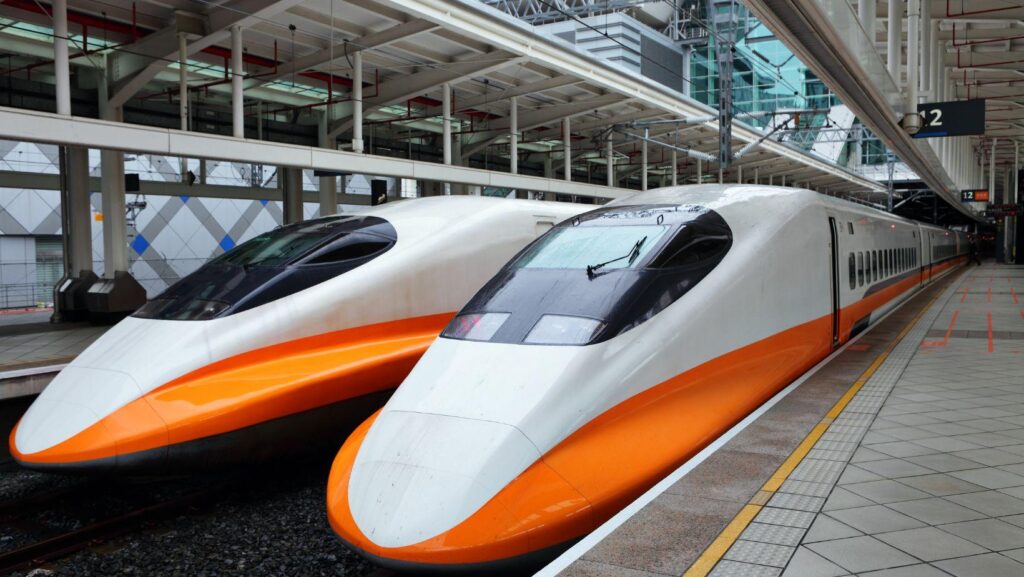
High-speed rail represents one of the greatest achievements in transportation engineering. Gliding across countrysides at speeds exceeding 200 miles per hour (320 km/h), modern bullet trains carry millions of passengers safely while offering a low-carbon alternative to regional air travel.
Achieving these extreme speeds requires far more than dropping a powerful engine onto standard train tracks. Every aspect of a high-speed rail system—from aerodynamic nose shaping and track geometry to electrical power collection and braking systems — is engineered to minimize physical resistance, maximize energy efficiency, and maintain smooth stability.
Aerodynamics, Pressure Waves, and Tunnel Entry Mechanics
As a train speeds up, air resistance becomes its largest physical obstacle. Aerodynamic drag increases exponentially with speed, meaning doubling a train’s velocity quadruples the wind resistance pushing against its front car.
High-speed trains feature long, streamlined nose cones designed using computational fluid dynamics. This specialized shaping serves a vital structural purpose: preventing micro-pressure waves. When a high-speed train enters a narrow tunnel at full velocity, it pushes air forward like a piston, creating a steep compression wave. Without an elongated, tapered nose design, this pressure wave blasts out the far end of the tunnel as a loud sonic boom.
Whether passengers are catching up on remote work, reading books, watching the landscape pass by, or logging into their favorite mobile entertainment apps, like streaming a show or visiting a licensed Spin And Win Casino, a smooth, aerodynamic profile ensures a whisper-quiet ride inside the pressurized cabin.
|
Engineering Component |
Physical Mechanism |
Primary Performance Function |
|
Streamlined Nose Cones |
Reduces frontal aerodynamic drag coefficient |
Minimizes air resistance and prevents tunnel boom pressure waves |
|
Continuous Welded Rail |
Eliminates rail joints using thermite welding |
Prevents wheel thumping, vibration, and track wear at high speeds |
|
Pantograph Collectors |
Maintains spring-loaded contact with overhead wires |
Delivers high-voltage AC electricity without dynamic contact loss |
|
Regenerative Braking |
Converts kinetic energy back into grid electricity |
Slows the train smoothly while recycling electric power |
Track Geometry and Continuous Welded Rail
Standard railway tracks use short steel rails bolted together, leaving small gaps that produce a rhythmic “clack-clack” sound as train wheels pass over them. At 200 miles per hour, these tiny gaps would shatter steel wheels and derail the train.
High-speed networks use Continuous Welded Rail (CWR), fusing steel rails into multi-mile segments using thermite welding. The rails are anchored to heavy concrete ties set in deep ballast stone or concrete slab tracks, keeping the line smooth and straight.
To handle high velocities safely, engineers build tracks with wide curve radii, often stretching over three to five miles per curve. Curves are bank-tilted (canting) to balance centrifugal forces, ensuring passengers do not slide in their seats as the train takes turns at high speeds.
Power Delivery and Dynamic Braking Systems
High-speed trains rely on clean, continuous electric power pulled directly from overhead catenary wires suspended above the tracks:
- Pantograph Dynamics: A roof-mounted mechanism called a pantograph presses against the overhead wire using pneumatic pressure. The pantograph must maintain constant contact with the wire even as the train bounces slightly, preventing electrical arcing at top speeds.
- Regenerative Electric Braking: When slowing down from high speeds, traction motors act as electrical generators. The system converts the train’s massive kinetic energy back into electrical power, feeding it straight back into the grid to power other trains on the line.
- Eddy Current Magnetic Brakes: For emergency stopping, non-contact magnetic brakes drop down near the rails. By generating strong opposing electromagnetic fields, eddy currents slow the train smoothly without mechanical friction or brake pad wear.
The Frontier of Magnetic Levitation (Maglev)
The absolute frontier of high-speed ground transit moves beyond steel wheels entirely. Magnetic Levitation (Maglev) trains use superconducting electromagnets to lift the train cars several inches above a specialized guide track, eliminating mechanical friction completely.
With friction removed, experimental Maglev systems can reach speeds over 370 mph (600 km/h). As rail technology continues to advance, high-speed networks will remain a masterclass in modern physics, moving humanity quickly, cleanly, and safely into the future.